

What to Know First
Understand contact state, supervised circuits and common relay terminology.
- NO and NC describe the contact in its defined normal, de-energised condition.
- The safer state depends on supervision and the required response - not the label alone.
- Draw the complete current path and test power-loss and cable-fault cases.
The label describes a contact, not the outcome
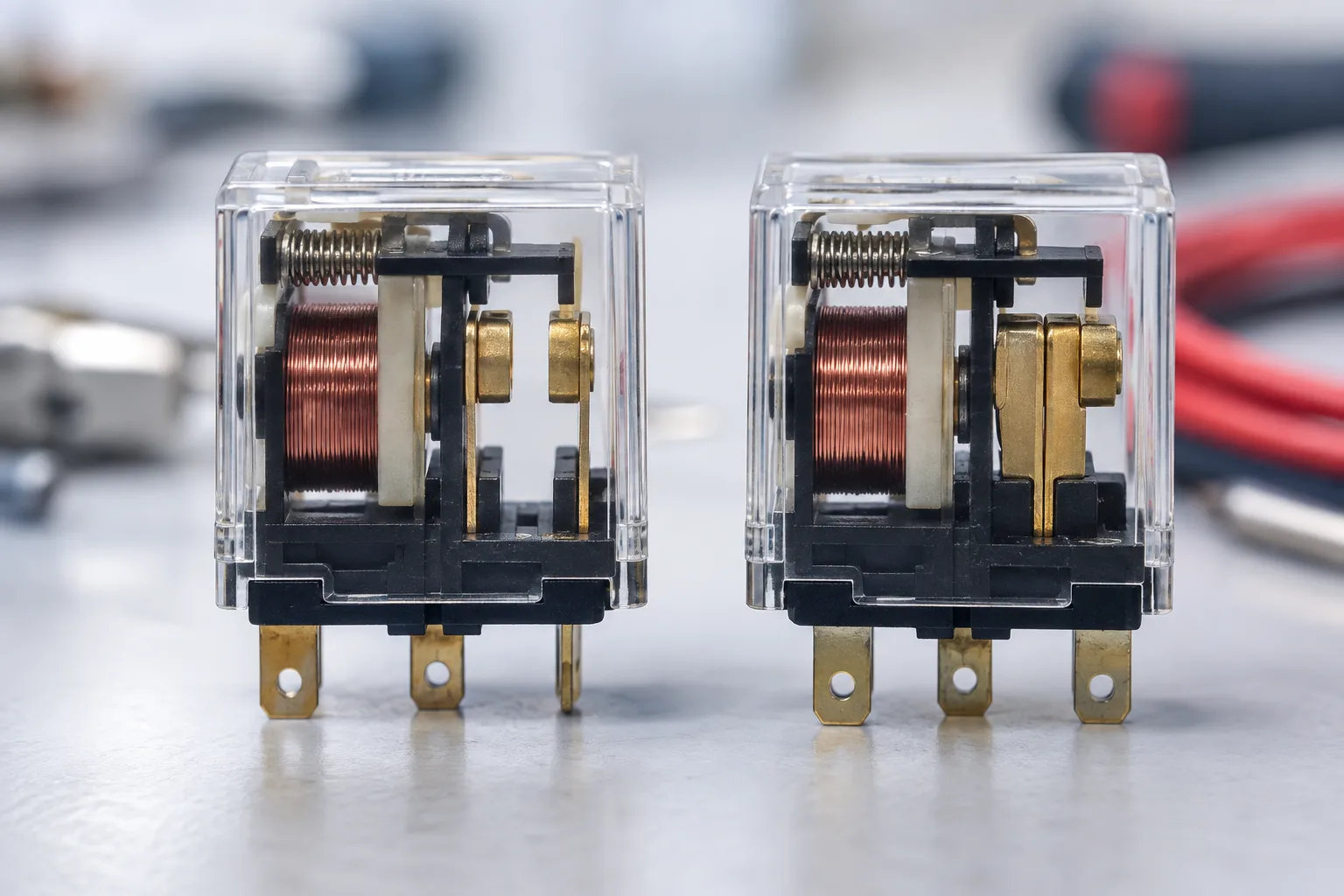
A normally open contact is open when the relay is in its defined normal, de-energised state. A normally closed contact is closed in that state. Once the coil is energised, the two states swap.
This does not tell you whether a damper will close, a fan will stop or a signal will be seen. That depends on the entire circuit and the controlled equipment.
Why fail-safe circuits need more thought
A normally closed path can reveal a broken wire because loss of continuity changes the input. It can also produce unwanted operation if the circuit is not designed and supervised correctly. End-of-line components let a fire panel distinguish normal, alarm and some fault states.
Agree whether a cable fault should create fire action, a fault warning or both.
- Show COM, NO and NC on the drawing
- Mark the de-energised state
- Show end-of-line values and location
- Test alarm, fault, loss of power and reset
Ratings still apply
A relay contact has limits for voltage, current, inrush and load type. Inductive loads such as coils and motors can be harder to switch than a simple resistive load.
Use an interposing relay or approved interface where isolation, rating or monitoring requires it.
Project Checklist
What ‘normal’ means for the equipment, relay and process.
Dry or powered contact, voltage, current and load type.
How open circuit, short circuit and earth fault are detected.
What happens on power loss, reset, isolation and relay failure.
Frequently Asked Questions
Is normally closed always fail-safe?
No. It can help reveal loss of continuity, but the power supply, supervision, relay state and controlled equipment must be reviewed together.
Official references
Information is based on reviewed sources and our experience at the date shown. Use it at your own risk and verify current codes, certificates and project conditions. Report an issue or suggest a correction.